New Orleans Voodoo: part one
Okay, I know it's been a few weeks, but now my computer is moving at snail speed, so while I work to buy a new one, I've managed to get this post together for all of you. I'm very excited about this one because I absolutely love anything out of the ordinary, including creepy, spells, supernatural, etc.
So today we're talking about the History of New Orleans Voodoo. I had so much fun researching for this topic and cannot wait to visit NOLA, hopefully sometime in the near future.
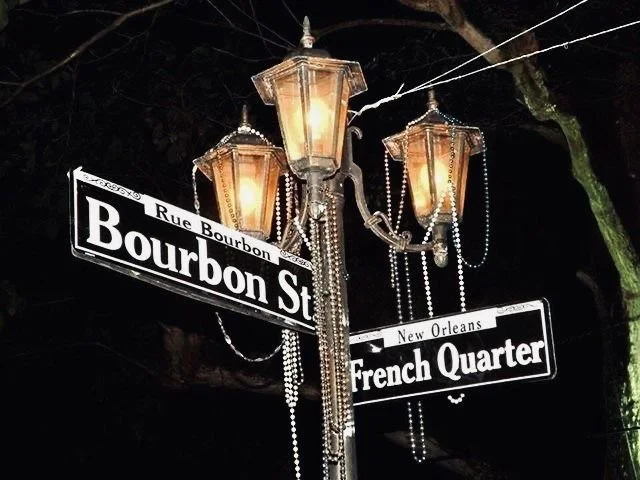
How many of you actually know the history behind Voodoo and why it's centered in New Orleans?
Following my research, both articles being used for this discussion today claim voodoo came to New Orleans with enslaved Africans who brought their practices and rituals over to the Americas. These rituals and practices were typically through religious means and spread to local Catholic populations. Within New Orleans, Voodoo is a religion often termed Voodoo-Catholicism. This religion puts focus on nature, environment, and spiritual inflictions, including ancestral importance. Reinforcing the prospect that enslaved Africans brought this religion over is stated in the article, “New Orleans Voodoo: The Voodoo That New Orleans Can Do”, relaying that, “Voodoo was bolstered when followers fleeing Haiti after the 1791 slave revolt moved to New Orleans and grew as many free people of color made its practice an important part of their culture.” Significantly, those who traveled to New Orleans became significant political “kings and queens” of Voodoo in the 1800s. Originally, “These traditions brought a vibrant pantheon of spirits, a belief in the power of ancestors, and powerful rituals involving music, dance, and trance.” This was before Catholicism intertwined with their beliefs, meaning powerful spirits associated with Voodoo were then misrepresented as Catholic Saints. When the slaves were brought over from West Africa/Haiti, the plantations they were on pushed the catholic religion; however, in an urgency to keep their traditions, they adapted to include their practices with Catholicism. More and more Haitian refugees, free and enslaved, traveled into the Americas; meaning more and more Vodou practices developed and adapted, enriching the already growing religion. The community it created was extraordinary, turning places such as Congo Square, now known as Louis Armstrong Park, into places those engaged in the religion could gather and continue their practices.
It’s important to note that throughout this entire post, many names are listed for ‘Voodoo ‘; you’ll have seen the traditional Voodoo, Vodou, or Voudon, all referring to relatively the same practice.
It’s anticipated that everyone who reads the word Voodoo expects the dolls and resurrected zombies to be what the religion is about, but this is far from true. Voodoo/Vodou/Voudon is described as, "a whole assortment of cultural elements: personal creeds and practices, including an elaborate system of folk medical practices; a system of ethics transmitted across generations [including] proverbs, stories, songs, and folklore... voudon is more than belief; it is a way of life," established by Leslie Desmangles, a Haitian professor at Hartford's Trinity College. We will get more into this side of Voodoo in part two!
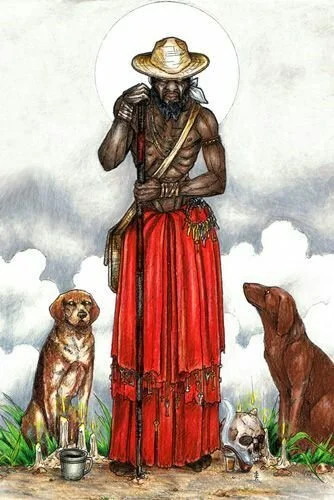
Let’s talk about some of the powerful spirits commonly addressed in Voodoo that became intertwined with Catholic Saints. One being Papa Legba, the gatekeeper of the spirit world. “Papa Legba is Vodou’s essential gatekeeper, bridging human and spirit realms. Originating from West Africa (Fon/Ewe), he’s honored with offerings (tobacco, rum, coins) to open pathways and communication. Every ritual begins by invoking him.” When Catholicism entangled with Vodou, Papa Legba was often related to Saint Peter from the Catholic religion. However, Papa Legba remained crucial to the Voodoo religion alone. Indications state that he is the MOST important Haitian Vodou (yes, I spelled it right; there is Vodou and Voodoo!) and New Orleans voodoo.
In saying all of this, the spirits that people call upon and try to communicate with are called Lwa, which, in literal terms, means spirits. It is said that he is a linguist of the Lwa, translating human prayer and offerings to something the Lwa (spirits) can understand, and the same for the Lwa to human dialect. Papa Legba dates back ages and is commonly known/associated with the Vodun religion, where he is seen as “ a powerful, often trickster-like deity associated with crossroads, communication, and the breaking down of barriers.” He has been described as a frail older gentleman often walking with a crutch or stick, the frailness disguising his immense power and the crutch being the point of power in which he can communicate back and forth between realms. Every single ceremony or ritual within the voodoo/vodou religion must begin with an incantation to Papa Legba.
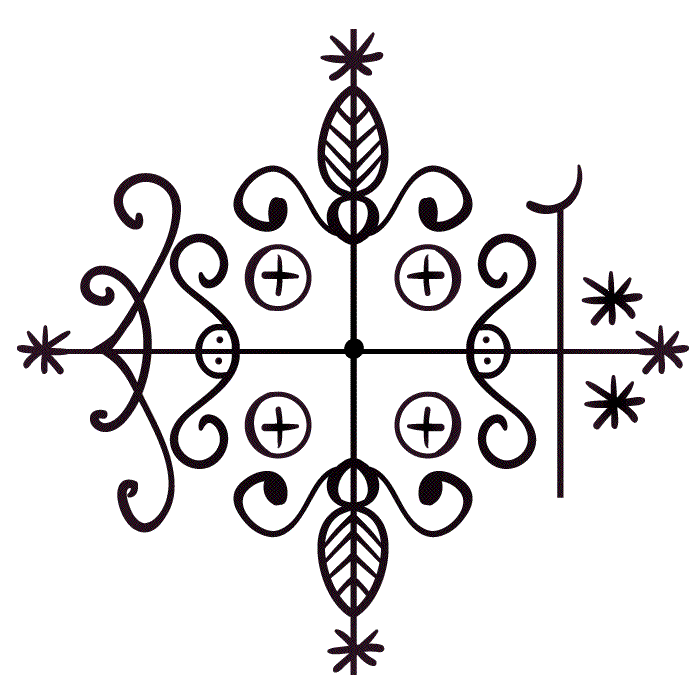
This symbol is commonly used to invoke Papa Legba and begin communication. The connections between Papa Legba and Saint Peter are simple. Papa Legba holds the keys to the spiritual crossroads for communication between humans and Lwa(spirits), and Saint Peter holds the keys to the gates of heaven.
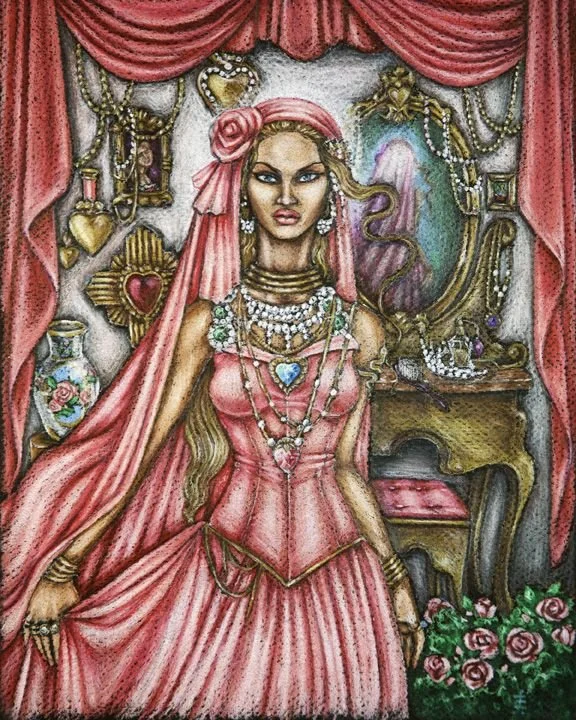
Similar to Papa Legba and Saint Peter, Erzulie Freda is often compared to the Virgin Mary. Lady Erzulie is often described as incredibly beautiful, covered in jewels, silk, and lace, and favoring the colors pink, white, and blue, which signify love, purity, and serenity. She is said to appear in communications, moving delicately and being capable of changing her tone to be more demanding as needed. Within one article, they describe her origin and significance: “In the syncretic traditions of Haitian Vodou and, by extension, her presence in some expressions of New Orleans Voodoo, Erzulie Freda is strongly identified with the Virgin Mary, particularly the Mater Dolorosa (Our Lady of Sorrows) or Our Lady of Lourdes.”
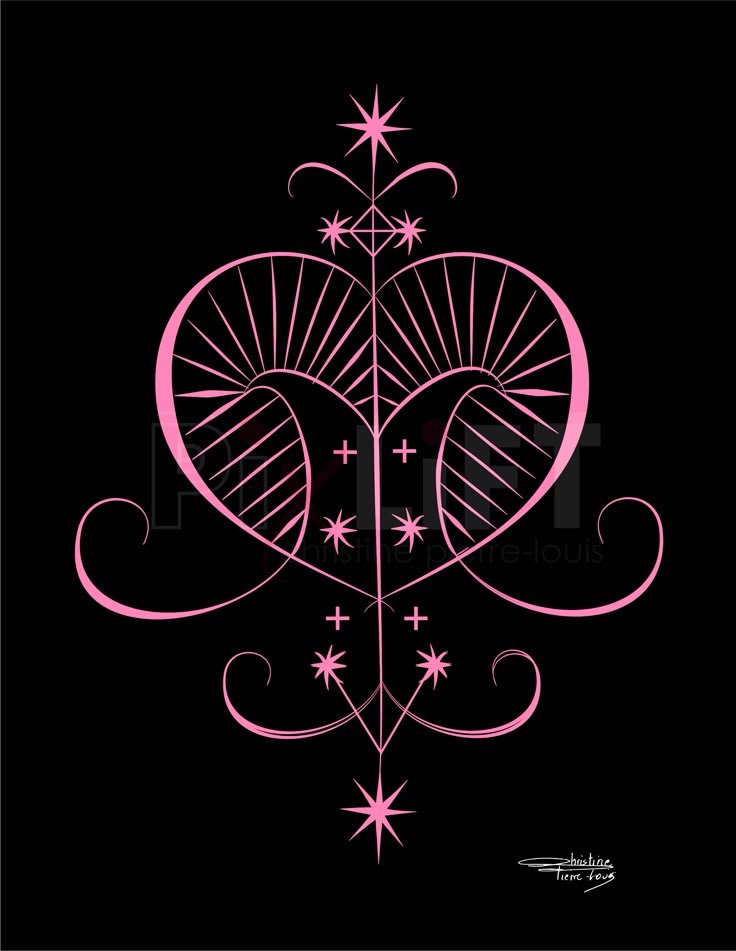
When Lady Erzulie is evoked for a ceremony, she is said to possess the practitioner, and the vodou priest/priestess (hungan or mambo) will ensure the ceremony proceeds properly. “Erzulie Freda, despite her outward glamour, can also be quite demanding, jealous, and even manipulative if not approached with proper respect and understanding. She expects to be treated like a queen and can withdraw her favor if neglected or dishonored. It’s a reminder that beauty and love, while desirable, come with their own complexities and responsibilities.” A beautiful testament that reins in the power of Lady Erzulie as well as the deeper, more intentional side of her. The symbol, when used, is represented as a heart, as her powers surround love and serenity. This symbol, aligned with Papa Legba’s symbol, can be used to open communication. When planning offerings for her, they should be done with utmost respect and presentation, as she loves extravagances. Sincerity and beauty are so important in the offering.
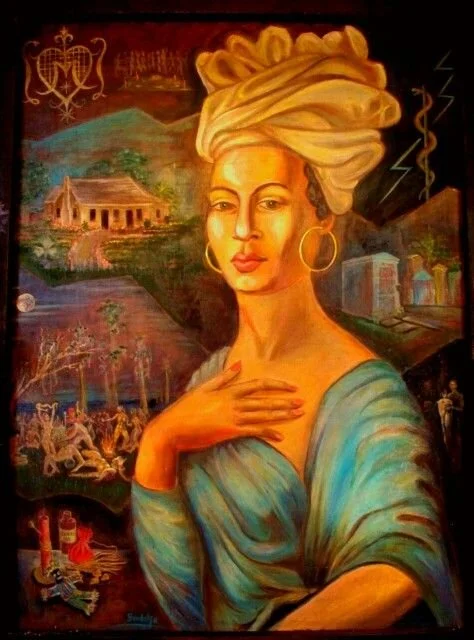
Now I'm sure many have heard this name at least once in their lifetime, but the conversation now turns to the famous Marie Laveau. Marie Laveau, born in the 1800s in the French Quarter, New Orleans, is known for her renowned influence in Voodoo practice. She was a free woman who was a hairdresser, healer, and influential spiritual leader. She had great knowledge of herbs and was dedicated to her community. Marie was also incredible at understanding how to merge rituals and ceremonies with Catholic symbols that gave all communities somewhere to fit in via religion. Marie Laveau's influence showed the importance of compassion; she dedicated her time to care for sick people, teach others about spells and rituals, and how to respectfully hold ceremonies. Her influence is still greatly appreciated, as even in the afterlife people call to her for assistance by leaving offerings at her tombstone.
Well, that’s all for part one of this discussion! In the next post, we will further discuss Marie Laveau’s influence as well as deeper roots in the origin of Voodoo. Thank you all for reading; I hope you enjoy it. See you next week with part two! (We might even make a part three; this topic just speaks to me and is so intriguing, and there is SO much to uncover!)
Goodbye for now; see you in the next one!
REFERENCES AND LINKS USED FOR THE POST:
The History of New Orleans Voodoo – Louisiana Voodoo
History of Voodoo In New Orleans - New Orleans & Company
Papa Legba: The Gatekeeper of the Spirit World | Offerings, Rituals & Meaning – Louisiana Voodoo
The Origins of Voodoo, a Misunderstood Religion | Ancient Origins
